
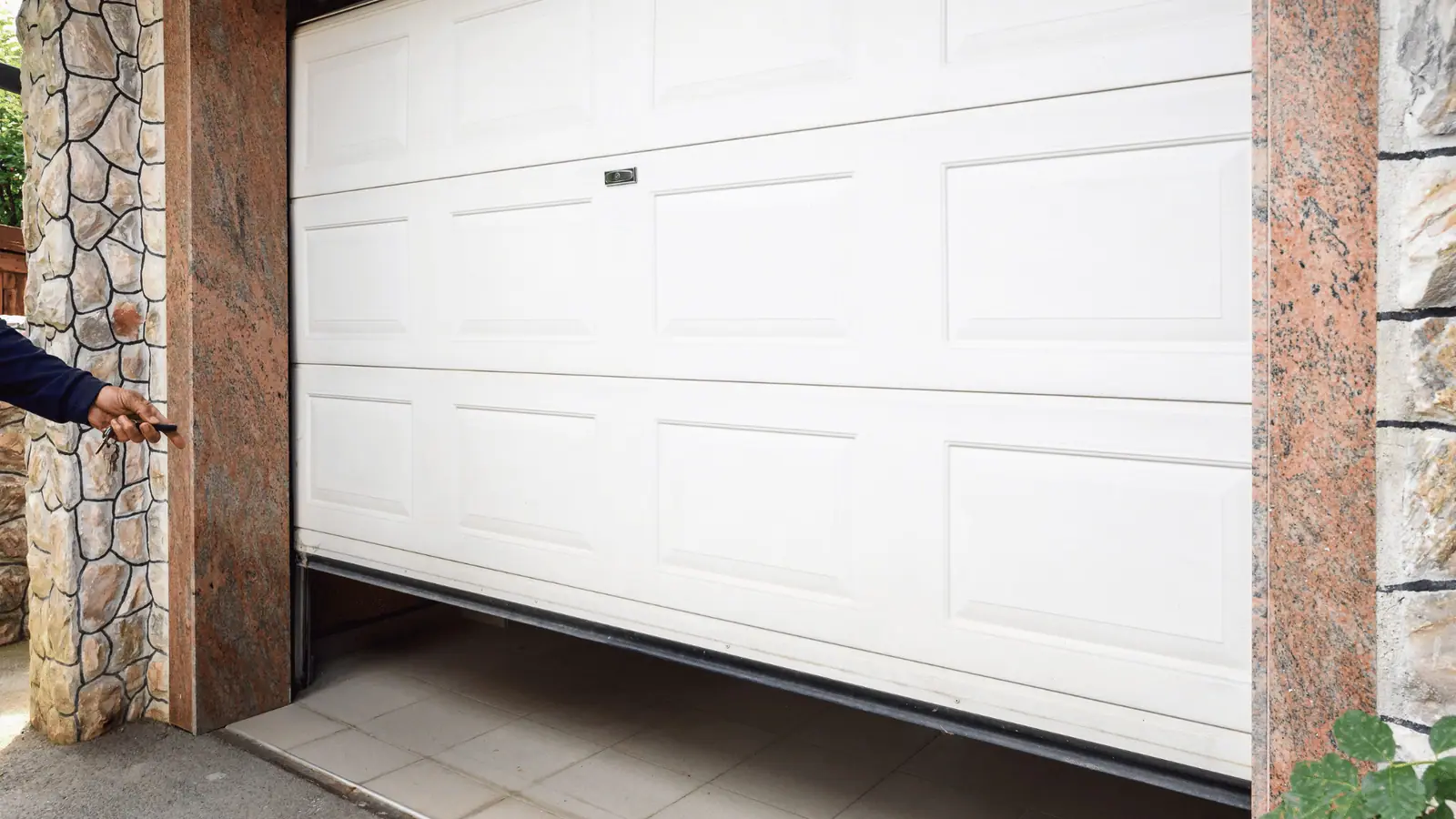
A garage door that refuses to open usually has one of a handful of causes, and several of them take a minute to check. This guide walks through the checks in a sensible order and explains where to stop and call a professional.
It is written for the common automatic garage doors found on Australian homes. If you have a manual door, skip to the sections on tracks, springs and obstructions.
Start with the remote and the wall button
Press the wall-mounted button first. If the door moves with the wall button but not the remote, the problem is almost always the remote: a flat battery, a remote that has lost its pairing, or interference. Replace the battery, stand closer to the door and try again. If you have a second remote, test that as well.
If neither the wall button nor the remote does anything, move on to power.
Check the power supply
Confirm the opener is plugged in and that the power point works by testing it with another device. Look at your switchboard for a tripped safety switch or circuit breaker, and think about whether there has been a power outage. Many openers show a light or a flashing pattern when they have power but a fault; the manual will explain what the pattern means.
Look at the safety sensors
The small sensors on either side of the door, close to the floor, mainly stop the door from closing on something. A dirty, blocked or knocked-out-of-line sensor usually affects closing, but it can also make an opener behave oddly, with flashing lights or no response. Wipe the lenses, check that nothing is in the way and that both sensors point at each other.
Work out whether it is the opener or the door
Pull the emergency release cord (usually a red handle) so the door is disconnected from the opener. Do this only while the door is fully closed.
If the door lifts easily by hand
A door that lifts smoothly and stays roughly where you leave it, around half way, suggests the springs and tracks are fine and the fault is in the opener or its settings.
If the door is very heavy or will not move
A door that feels extremely heavy, will not lift, or drops when you let go points to a spring, cable or track problem. Stop there and do not force it.
Safety note: Garage door springs and lift cables are under very high tension. Do not try to adjust, loosen or remove them yourself. A broken or slipping spring can cause serious injury, so leave spring and cable work to a trained technician.
Inspect the tracks and rollers
With the door closed and disconnected, look along both tracks for objects, bent sections or rollers that have come out of the track. Remove anything loose that is clearly in the way, but do not try to bend a track back or force a door that has come off its track.
Signs of a broken spring or cable
Common signs include a loud bang from the garage earlier, a door that is suddenly heavy, a visible gap in a coiled spring, a frayed or hanging cable, or a door that sits crooked. Our guide to signs your garage door spring needs replacing covers these in more detail.
When to call a professional
- You suspect a broken spring or cable.
- The door has come off its tracks or the tracks are bent.
- The opener hums or clicks but the door does not move.
- The fault keeps coming back after you have checked the basics.
If you are in Ipswich, our garage door repairs page explains what is involved. You can also read our garage door maintenance checklist to help avoid problems in future.
Frequently asked questions
Why does my garage door open with the wall button but not the remote?
That usually means the remote battery is flat or the remote has lost its pairing with the opener. Try a new battery first, then check the opener manual for how to pair the remote again.
Can I open my garage door by hand if the power is out?
Usually yes. Pull the emergency release cord while the door is closed and lift the door by hand. If it feels very heavy, do not force it, because that can mean a spring or cable problem.
Is it safe to fix a broken spring myself?
No. Springs and cables are under high tension and can cause serious injury. Leave them to a trained technician.